
Street Karting in Tokyo, Round Two: Picking a Store in a Different Area and Planning for Those Who Won't Drive
Street Karting in Tokyo, Round Two: Picking a Store in a Different Area and Planning for Those Who Won't Drive
"I want to go karting again, like last time!"
Imagine a friend from overseas, back in Tokyo for the first time in years, saying that with bright eyes. What do you say? Booking the same store as last time is a safe choice. But hold on. A second time can be fun in its own way. You can change the scenery along the route. You can decide who drives this time and who doesn't. You can even plan how the people waiting will spend their time. Let's work out an approach that helps when you're showing Tokyo to a group with mixed ages and energy levels.
What a returning driver is looking for
The first street kart ride is all about the ride itself.
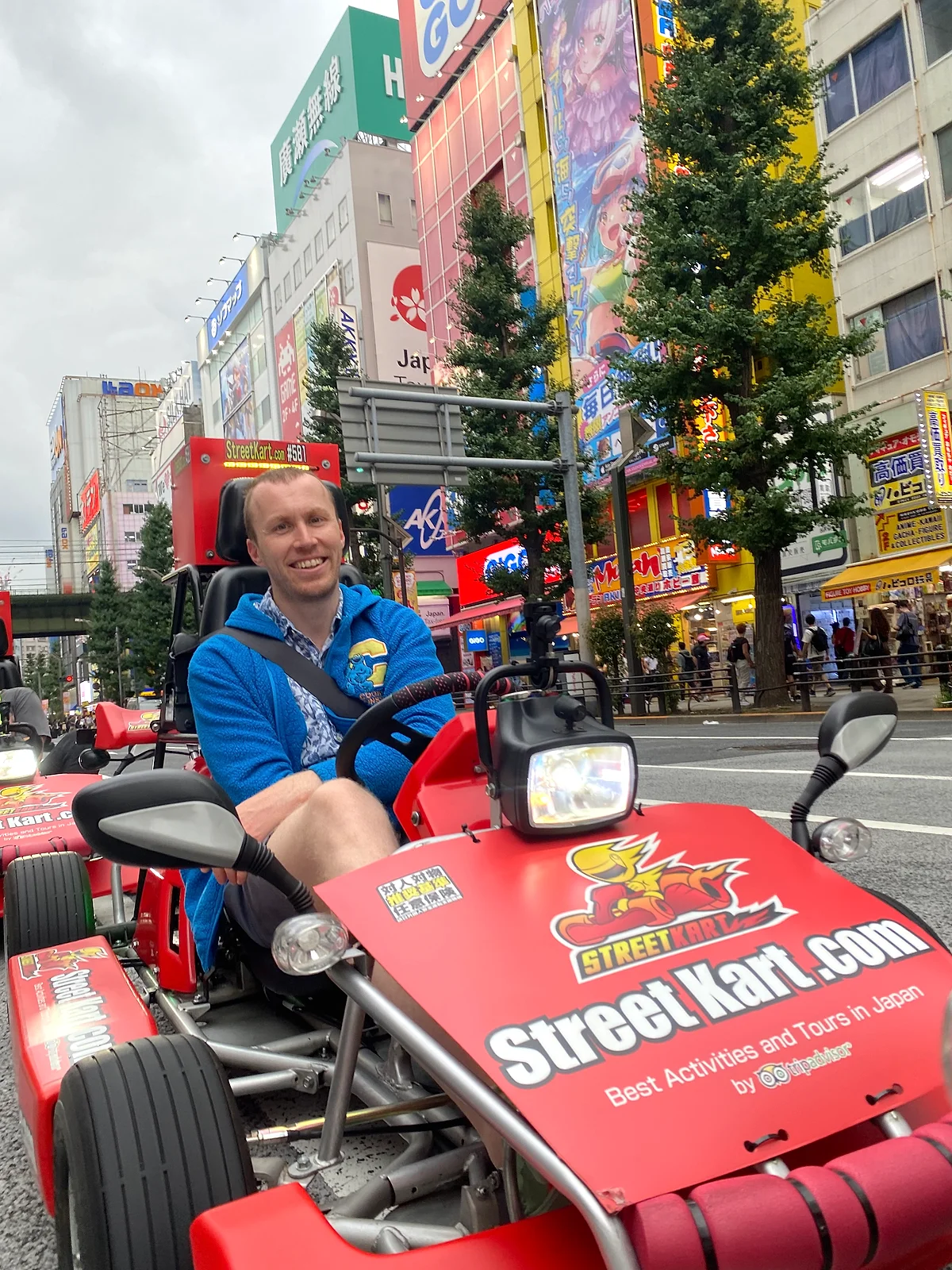
The open-top seat sits low. The tires of the bus in the next lane are at eye level. When you stop at an intersection, you can hear pedestrians talking as they wait for the light. A gust of wind from between the buildings slips in through your sleeves. It's a chance to take in Tokyo with your whole body, not just your eyes. Anyone who has ridden once already knows this feeling.
That's why repeating the same ride brings less surprise the second time. In surfing terms, it's like riding the same wave at the same spot twice. Not bad at all. But head to a different spot and the same board meets a very different ocean. The same idea works for street karting in Tokyo.
One thing to keep in mind: street karting is a guided tour with a guide in front. Each store and tour has a set route, and you can't detour wherever you like along the way. So on a second visit, you can change two things: which store's tour you join, and how you use the time before and after. Just two things. But those two can completely change the experience!
How the scenery along the route differs by Tokyo store
Street Kart has 9 stores across Japan: 7 in Tokyo, 1 in Osaka, and 1 in Okinawa.
Let's be careful here, though. Some of the 7 Tokyo stores sit right next to each other, like Akihabara stores No. 1 and No. 2, or Shibuya and Shibuya Annex. You don't get "7 different neighborhoods to choose from." Thinking in terms of areas makes the choice easier: Akihabara, Shibuya, Shinagawa, and the Tokyo Bay store in Shinkiba. With these four in mind, let's look for scenery you didn't see last time.
Note that the actual roads a tour takes can vary. The places below are listed as highlights along each store's routes. To be safe, check your tour's route on the official website before booking.
If you went from Shibuya last time, try Akihabara next, toward Tokyo Station and Ginza
Along the Shibuya store's routes are the Shibuya Scramble Crossing, Harajuku's Takeshita Street, and Omotesando with its rows of zelkova trees. Waves of people, colorful shopfronts, glass-walled luxury brand buildings. It's a cityscape that lets you take in all the energy of present-day Tokyo.
If your friend saw all that last time, I'd recommend the Akihabara store.
Along its routes are the red-brick Marunouchi Building of Tokyo Station, the Wako clock tower at the Ginza 4-chome intersection, and the Kabukiza Theatre. Take a moment to picture just one of these. Past the signboards of the electronics district, the red-brick station building stretches out wide. It opened in 1914, and its restoration was completed in 2012. Looking up at it from the low seat of a kart, you should really feel its weight. It's the same Tokyo, yet the city feels like it's from a completely different era. The more familiar someone is with Shibuya's pace, the fresher this calm scenery of stone and brick will feel to them.
If you went from Akihabara last time, catch the bay breeze from Shinagawa or Tokyo Bay
For those who drove through the city streets of Akihabara, a store near the water is a good fit.
Along the Tokyo Bay store's (Shinkiba) routes are the 798-meter Rainbow Bridge, the 333-meter Tokyo Tower, and the Fuji TV headquarters building in Odaiba. The moment you leave the warehouse district for the open road, the wind picks up a hint of salt. You know that feeling when your shoulders relax as you drive along the sea? The sky above feels far wider than it does between the buildings!
The Shinagawa store's routes also take in the Rainbow Bridge and Tokyo Tower, along with bayside scenery around Takanawa and Shibaura, Tamachi. At night, the Rainbow Bridge is lit up in seven colors. If your friend has already driven in daylight, it's fun to compare how it looks after dark. Departure slots and driving hours vary by tour, though. If you have a preference, check when you book.
If you went along the bay last time, head into the crowded heart of Shibuya
On the other hand, if your friend went from Tokyo Bay or Shinagawa last time, choosing Shibuya changes the scenery completely. From the open feel of the sea and the bridge to the buzz of the Scramble Crossing, and then into the green tunnel formed by Omotesando's trees.
Some Shibuya tours run from the Scramble Crossing up Dogenzaka, through Omotesando, and on to Harajuku. Omotesando is also known as a street lined with distinctive buildings designed by architects. After the bayside warehouses and high-rises, a row of buildings where every facade is different should be interesting in a whole new way.
Whichever store you start from, pick "the other side of Tokyo" the second time. That alone turns the same street kart ride into a different trip.
How to organize a group where some drive and some don't
Now for the main point. When you're touring Tokyo with a group of mixed ages and energy levels, there's one thing to decide first.
Karts are single-seaters. You can't put someone beside you or hold them on your lap. Not everyone will be able to drive. That's why you should settle "who's driving this time" first. That alone makes the day far less hectic.
To drive, you need a license that meets the requirements. For a friend from overseas, a license from their home country alone may not be enough. The required documents depend on the country and type of license. Rather than having the host decide, it's more reliable for your friend to read the driver's license information on the official website themselves. This article doesn't give definitive answers on age or other requirements either. Always check the latest requirements on the official website.
The Street Kart website is available in 22 languages. Take a look together to see if there's a page in your friend's native language. I think it's better for them to read it with their own eyes than for the host to translate the Japanese information.
One more thing. Even someone who could drive last time may have had changes to their license situation since then. Don't assume "they could drive last time, so they'll be fine this time." Check every time.
People who've ridden once are often the first to say, "It was so much fun, let's bring Dad this time!" I completely understand the feeling.
But pause for a moment. Driving a low-seated kart through city streets, including getting in and out, may be hard on some people's bodies. As with hiking, the more fun the route, the more it matters that everyone can enjoy it in their condition on the day. The tour moves together with the lead guide and other participants. That's exactly why you should think about how each person is feeling before setting off.
The karts have no suspension, so every bump in the road goes straight to the seat. Pregnant people are advised not to take part and to consult a doctor. If anyone has health concerns, read the official website's guidance with them first, and then decide.
If anyone is unsure, don't push them to drive. Offer "enjoying it as the one who waits" as an option from the start. How you plan the non-drivers' time can make a big difference to the whole group's day.
Ways to spend time near the stores so waiting isn't just an afterthought
If someone won't be driving, you might even choose the store based on how that person will spend their time. The places below are all near the stores and are separate from the roads the tours take. Think of them as places to stop by before or after the ride, or while waiting.
Shinagawa Shrine, a 5-minute walk from the Shinagawa store, is one of Tokyo's Ten Shrines and has a Fujizuka (a miniature Mt. Fuji).
If you want to go a bit farther, Honsenji Temple is about a 10-minute walk away. It's home to one of the Edo Six Jizo statues and a large temple bell designated a Tangible Cultural Property of Tokyo. About 20 minutes on foot will get you to Sengakuji Temple, where the graves of the 47 Ronin of Ako are located. For anyone who enjoys a slow tour of temples and shrines, the waiting time becomes a small walking route of its own.
Those comfortable walking can head to Tennozu Isle, about 20 minutes away on foot. It's an area with cafés and art galleries along the canals. Meet up there with the group after the tour and relax while hearing about their drive along the bay. Doesn't that sound like a nice way to end the day?
From Akihabara, Ueno Park is about 5 minutes by train. It has Ueno Zoo, the Tokyo National Museum, and the National Museum of Western Art. Closer by, Kanda Myojin Shrine, a 10-minute walk away, is another option.
Tokyo Station is about 20 minutes on foot or 5 minutes by train. Inside the red-brick station building is the Tokyo Station Gallery. If the tour route includes Tokyo Station, those waiting can take their time admiring on foot the same station building their friends looked up at from the low seat of a kart.
Visit a museum while the drivers are out on the tour, then meet up in Akihabara afterward to shop for souvenirs. With this order, the people waiting also have a real "goal for the day."
Shibuya Scramble Square, about a 10-minute walk from the Shibuya store, has the Shibuya Sky observation deck.
Picture this for a moment. Your friends in karts are driving through Shibuya at eye level, just above the ground. Meanwhile, the people waiting are looking down at the same city from high above. Compare photos later and you'll have the same Shibuya side by side, from street level and from above. That's fun! Also within a 10-minute walk is the Hachiko statue, a famous meeting spot.
If walking isn't a problem, Meiji Jingu Shrine is about 20 minutes away on foot. It's a shrine wrapped in a vast sacred forest right in the middle of the city, with a quiet that contrasts sharply with the buzz of the Scramble Crossing.
The Tokyo Bay store in Shinkiba is a bit farther from nearby attractions. Odaiba and Toyosu Market are about 10 minutes by car, and Kasai Rinkai Park about 15 minutes by car. If you'll spend time at the park, with its giant Ferris wheel and Tokyo Sea Life Park aquarium, decide in advance how you'll get there and back.
The stores have no parking. Tour participants should come by public transportation. The store is an 8-minute walk from Shinkiba Station.
The stores have lockers for small items, but they aren't suited to large luggage like suitcases. If you're fitting this into a travel day, decide in advance where to leave large bags.
Key points for a second visit
Here are the key points to keep in mind when considering Street Kart for a second visit.
First, each tour is led by a trained guide. Your friend from overseas will drive behind the guide.
Second, guidance on tour day is basically in English. Guidance in Japanese or other languages depends on the staff that day and can't be guaranteed. If this concerns you, it's a good idea to contact them in advance through the official website.
Third, the website is available in 22 languages.
Fourth, even within Tokyo, the scenery along the routes differs clearly by area: from Akihabara to the red-brick station and Ginza, from Shibuya to the Scramble Crossing and Omotesando, and along the bay to the Rainbow Bridge.
Fifth, there are places near the stores where non-drivers can stop by.
Sixth, the track record. As of November 2023, across all stores, there had been over 150,000 tours, over 1.34 million customers, and over 20,000 reviews, with an average rating of 4.9 out of 5. These are figures as of November 2023, not current ones.
Things to double-check before booking, especially for a second visit
Finally, a word on arrangements. Weekends tend to book up, so if you're going on a weekend, act early. Check the official website for the latest information on how and where to book.
Before booking, checking things in this order helps you avoid missing anything:
First, decide who's driving, and have that person check the license requirements on the official website themselves. Second, choose a store in a different area from last time, and check what's along its routes on the official website. Third, decide where the non-drivers will wait and where you'll meet up.
Then there's the weather. Since the karts have no roof, the conditions make a big difference to how the ride feels. Check the official website for what happens in rain and for clothing guidelines. Bringing an extra layer makes it easier to adjust on days when the temperature is hard to predict.
According to Street Kart's guidance, tours run in light to moderate rain, and raincoats are provided. Tours are canceled in heavy rain or typhoons. Drivers are recommended to wear closed-toe shoes such as sneakers. Heels, open-toe shoes, skirts, and dresses are listed as things to avoid.
Anyone who has ridden once already knows how fun karting is. So on a second visit, the host only has two jobs. Choose Tokyo scenery your friend hasn't seen yet. And plan the day so everyone in the group goes home smiling, including those who don't drive.
Who's driving? Who's waiting, and where? Where will you meet up?
Once those are settled, you're ready. Check the stores and tours on the Street Kart official website and head for your next Tokyo. This time, let's go drive the other side of Tokyo together!
This article was originally written in Japanese and translated using AI. Some expressions may read unnaturally, and we appreciate your understanding. For the most accurate and up-to-date information, please refer to the official site at kart.st.
Street Kart is not affiliated with Nintendo or the Mario Kart series in any way. We do not provide costumes of Nintendo characters, and such costumes may not be worn during tours even if brought by participants.